Sandra Abraham-Hebert, M.D., a gynecologist and obstetrician practicing in suburban Washington D.C., is featured in Ultimate Guide: Pregnancy
on Discovery Health Channel.
Q:
What are the first changes that happen to a woman when she becomes pregnant, even before she realizes she's pregnant?
A:
Even before she knows she's pregnant, she'll notice breast changes. Her breasts become tender. Her nipples become tender. Her breasts enlarge ever so slightly and increase during the entire pregnancy. Some other changes are generalized gas production, so constipation as well as gas bloating of the belly occur. These are some of the changes that people come into the office complaining of when they don't even know they're pregnant.
Other early changes occur in the skin. There are some ever-so-slight pigment changes in the face or all over the body. Some women can get increased oil production and acne as well in early pregnancy.
Q:
It is said that pregnancy puts added stress on your heart. What cardiovascular changes occur during pregnancy and how is the heart able to deal with them?
A:
During pregnancy, the blood volume increases dramatically, probably by about 40 to 50 percent. That's a large blood volume for a woman, but amazingly, the body compensates very, very well.
During early through middle pregnancy, a woman running up a flight of stairs will notice that her heart's pumping away and she'll get a little lightheaded. Her cardiovascular system is taking some time to compensate. As the pregnancy progresses, she will have to be aware of these changes and actually slow down so that the symptoms have some time to settle down a little bit. The increased blood volume is a pretty big load on the heart and lungs. But women are made to actually compensate for that.
Q:
What is it that makes a woman's body able to compensate for that?
A:
About 10 to 15 different hormones cause the actual increase of the blood volume and control the compensation mechanisms that the organs, including those of the cardiovascular system, use to accommodate those changes.
The lungs also go through many changes. The diaphragm actually rises. The diameter of your chest increases outwardly. Despite those adjustments, though, you often feel out of breath and you may feel that you can't take a deep breath or that you feel a little bit more out of breath. The hormones again have a big role to play in that and cause those changes and the compensating mechanisms as well.
Q:
I've read that the lungs actually work more efficiently in pregnancy. How is it that they're able to work more efficiently for that brief period in a woman's life?
A:
It used to be thought that the actual lung volume or capacity was lower or less efficient during pregnancy. But in reality studies have shown that there's actually an increase in the volume of the lungs. The efficiency is definitely greater, although a pregnant woman is actually more prone to getting lung infections that stay a little bit longer.
Q:
What are the additional nutritional needs of pregnant women?
A:
Even prior to pregnancy and during the very early stages of pregnancy, it's very important to have a balanced nutritional plate. The caloric requirements of the body increase to about 300 to 500 extra calories a day all throughout pregnancy. And breast feeding requires an additional 200-calorie increase on top of that.
In early pregnancy, nutrition has a big impact on fetal development. Amazingly, the body compensates and takes the fats, carbohydrates and proteins from whatever you give it, but if you have a healthier, balanced diet there are fewer problems in development. There's an increased need of folic acid — this has been in the media for quite a while. Studies have shown that folic acid actually decreases spinal problems and genetic problems.
Since nutrition is so critical, especially during the early stages of pregnancy, we tell women to actually start on prenatal vitamins even before conception, and to continue that all the way through pregnancy. But it's very vital in the very early stages of pregnancy, during the first four to eight weeks of early fetal development.
Q:
We've heard a lot about the dangers of smoking and drinking to the growing fetus. What are the dangers of those to the mother's body during pregnancy?
A:
Tobacco is extremely dangerous to both mother and fetus. It affects their respiratory systems greatly. It puts the mother at greater risk of getting infections and pneumonia, it worsens asthma, and depending on the time of year, these can be greatly increased.
Smoking can affect the mother's cardiovascular system as well, including how efficiently the heart is pumping. It can also affect skin changes and general well-being or mood. Smoke affects the weight of the fetus as well, causing a lot of low-birth-weight babies. Even though some women may think, "OK, I don't want to gain a lot of weight during pregnancy" and keep smoking, it actually affects the fetus, not just the mother's weight.
Alcohol has been well studied. Even small amounts and regular doses can cause fetal alcohol syndrome, which is a horrible outcome for the baby. These are two drugs that are so dangerous to moms and babies.
Q:
As the mother's belly gets bigger, as her baby grows, how are the abdominal muscles able to stretch?
A:
As the uterus grows and the abdomen distends, the actual muscles of the abdominal wall increase in size. Since it's over a long period of time, the body compensates very nicely.
Women who have had more than one or two pregnancies will sometimes get a separation of the muscles that run up and down the mother's abdomen and the rectal muscles. It usually doesn't happen in first-time pregnancies, but it can.
In general, though, these muscle tissues as well as the facia, which is a strong tissue underneath the skin and fat, are made to stretch very, very slowly and can incorporate the very large uterus.
Q:
What skin changes occur during pregnancy?
A:
Many hormones are responsible for the accommodation of the skin. The collagens, collagenase, even the increased progesterone has some effect on the increased elasticity of the skin during pregnancy.
Some of the most noticeable skin changes during pregnancy involve pigmentation. The "mask of pregnancy" is one that is often written about. It's a darkening of the skin usually around the sides of the face and the forehead.
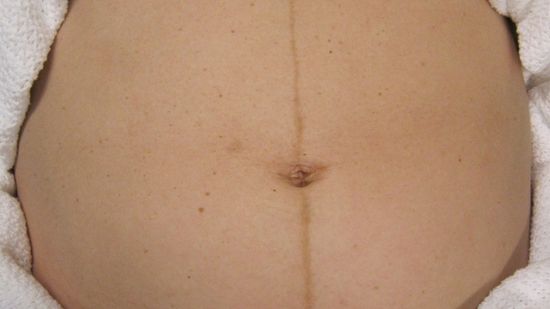
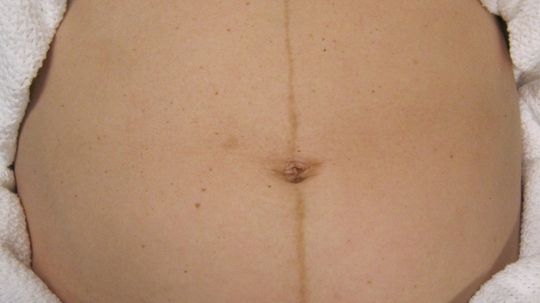
There can also be a change of the line down the abdomen. It's usually called a linea alba, which is a white line. During pregnancy it can become a dark line, called the linea nigra. This change sometimes occurs as early as the beginning of the second trimester, and increases and then disappears probably three to four months after delivery.
Some other common changes include little spider veins that pop up in the legs and sometimes on the arms and the abdomen. The reasons why these happen are not quite clear. We know that in many women, these spider veins disappear after delivery.
The pigment changes are probably due to the increase in the melanocyte-stimulating hormone during early pregnancy, as early as the first month, which then usually drops off after delivery. We don't know what levels are associated with women who get a lot of pigmentation.
Another common skin change during pregnancy is definitely acne. You'll notice outbreaks mostly on the face, but sometimes the shoulders and the backs of the arms. Again, there aren't any specific hormones that cause these, but increases in both estrogen and progesterone are known to cause acne throughout life.
Q:
Some pregnant women have changes in their vision and their hearing. What accounts for these changes?
A:
During early pregnancy, a lot of women actually experience a change in their vision, and have to get their prescriptions changed if they wear glasses. So we usually ask women to go ahead and get their eyes checked. Most of the time their hearing stays in check, but there can be changes. The reasons are again very unclear. It's most likely due to the change in the multitude of hormones. Their vision will sometimes return to normal, but most of the time, vision changes remain that way.
Q:
As pregnancy progresses and women get larger, what stresses are put on circulation?
A:
As pregnancy progresses, many women will come into the office complaining that their hands or feet are numb or that they're swelling. Again, with increases of hormones, particularly progesterone, in pregnancy, the vascular system becomes very leaky and increased tissue fluid is particularly noted in the hands, feet and legs.
Carpal tunnel syndrome is also very common in pregnancy because of that swelling. Sometimes women have to get wrist braces and elevate their legs or undergo hydrostatic pressure, like getting in a swimming pool or a bathtub, to feel better. Those conditions alone are not dangerous, but they are something that we do see in mid- to later-pregnancy.
Q:
Is there truth to the advice that you shouldn't lie on your back later in pregnancy?
A:
After about 20 weeks of pregnancy, we encourage pregnant women not to lie on their back anymore. At this point, the uterus is quite a bit heavier and it actually lays on the blood vessels that run up your back, the inferior vena cava and the aorta. The vena cava is the big vessel that carries the blood to the heart, and the aorta's the big vessel that carries blood away from the heart. They both become compressed, and some people will lose consciousness when pressure's applied to these vessels. Numbness and tingling can occur in the upper and lower extremities. After about five months, we encourage women to sleep on their sides instead.
Q:
What are Braxton Hicks contractions and what is their purpose?
A:
Braxton Hicks contractions are irregular contractions that happen even in very early pregnancy. As early as four to eight weeks, the uterus is noticed to exhibit very low-pressure, irregular contractions — maybe five to 20 a day. Most of the time they're not detected. When most women reach maybe 24 to 28 weeks, they will actually feel these contractions. Again, they're not painful, they're very low in pressure. Women typically notice a tightening that quickly passes.
Q:
How does a woman know she's in labor? What are the early signs?
A:
One of the early signs of labor would be regular contractions. We usually have women time their contractions, and tell them to call us if they're coming more than four to six times an hour and lasting at least 30 to 60 seconds. These are also stronger than Braxton Hicks contractions. They'll sometimes start with some mild cramping, and then increase to about four to six times an hour.
Q:
What exactly is a contraction?
A:
A contraction is the uterus muscles tensing at the same time. The uterine muscles are smooth muscles. They're involuntary muscles, which means that we don't have control of them. The parasympathetic system or the involuntary system of the body actually causes the uterus to contract.
Q:
You mentioned water breaking. What is that water?
A:
The water that the baby is enveloped in — the amniotic fluid — is actually fetal urine that's swallowed and then passed through the fetus's renal system and excreted again during pregnancy. It's sterile urine. The amniotic fluid also bathes the baby's lungs when the baby "inhales" it, which helps the lungs to mature properly.
Q:
What are the three different stages of labor?
A:
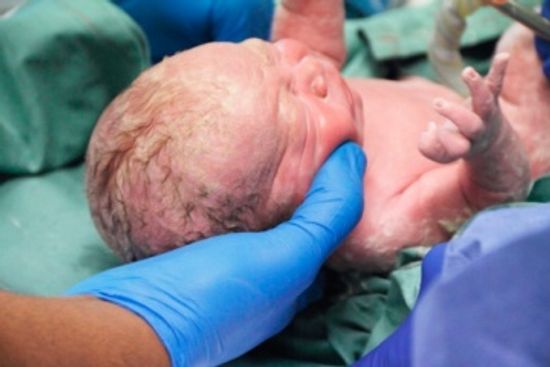
The first stage of labor begins when the initial strong contractions start and continues until the cervix is dilated fully. The second stage of labor begins with the mother pushing and ends with the expulsion of the baby. Stage three begins at the delivery of the baby and ends at expulsion of the placenta.
Q:
What changes occur to the cervix during early pregnancy?
A:
Many changes happen to the cervix during pregnancy. Early on, the cells on the outside of the cervix become hypertrophied or more prominent. During the first exam, very early in pregnancy, sometimes you can actually see a blue cervix, due to increased blood vessel changes.
Sometimes a little bit of bleeding can occur after normal activity or sex. Usually this is not dangerous, but it's very alarming to a newly pregnant woman. Another change that can happen due to hormonal changes is that the cervical opening can become a little more relaxed.
There are several other changes that happen to the pelvis. The pelvic ligaments relax quite a bit. The pelvic bone structure changes. The hips change in their diameter, and actually the hollow of the sacrum flattens with different positions in pregnancy.
As labor approaches, the pelvic opening actually widens a little bit. The pelvic bones separate ever so slightly, which can cause a lot of discomfort. In late pregnancy, there can be much pressure and pulling and tugging in the pelvic region, which we call round ligament pain, and that's usually in the groin area.
Q:
What happens to the pelvic area during later pregnancy?
A:
During the last four weeks of pregnancy, beginning at around 36 weeks and sometimes even a little bit earlier, many doctors will start checking the mother's cervix. During this time, the cervix will shorten or efface and it will start dilating, or opening. These things progress slowly until actual labor hits.
When labor begins, the dilation and the effacement progress much more rapidly. The cervix will dilate from 1 centimeter all the way to 10 centimeters. That's how we actually measure cervical dilation. Ten centimeters is where the cervix is at the point of delivery.
Around the same time the cervix will efface, or shorten, usually from a length of 3.5 centimeters all the way to where you can't feel any more cervical length.
Q:
While the cervix is effacing and dilating, what is the uterus doing to expel the baby?
A:
The rhythmic, powerful uterine contractions cause the cervical changes. Cervical change doesn't usually happen without uterine contractions.
The contractions are a physical tightening of the entire uterus. All those uterine smooth muscles work together in concert to squeeze the infant out as well as when the mother pushes. Of course the mother has to push to actually get the baby out, but the uterus itself is expelling the baby with the uterine contractions.
Q:
What accounts for the pain with labor and delivery?
A:
Labor pains are due to the uterus muscle squeezing and contracting. When muscles contract, it's very painful. Menstrual cramps are actually uterine contractions on a very smaller scale.
There are also chemicals produced in the body, the prostaglandins, that actually cause pain, and these are released during labor.
Q:
What factors might lead to a Caesarean-section delivery?
A:
Some of the factors that cause or contribute to a C-section would be slow progression of labor or no progression of labor. There's a certain speed to labor that is normal. We usually try to adhere to that to keep it safe for the mom and the baby.
What happens in many cases is that the pelvic bones are just not large enough to allow the passage of a certain size baby. If that's the case, the cervix may open to a certain number, say, to 4 to 5 centimeters, and just stop and stay at that number for two hours.
Usually a first-time mom who is experiencing good, strong labor contractions with no progress for several hours would be a candidate for a C-section. Another case would be if the cervix dilated to 10 centimeters and the mom was pushing for a certain amount of time without the baby appearing, we'd assume that the baby's just not going to be able to come out through the pelvic outlet. We allow a shorter amount of time for somebody without an epidural.
But there are two big reasons that C-sections happen. One big one would be where the fetal heartbeat would drop suddenly and stay down rather than recovering after a contraction. That would be an emergency and we would have to get the baby out.
The other situation would be if the fetal heart tracing just does not look normal regardless of the resuscitation that we're doing — oxygen and position change or putting some fluid back up inside the uterus. If things are just not looking healthy or safe for the baby or the mother, that would necessitate a C-section.